


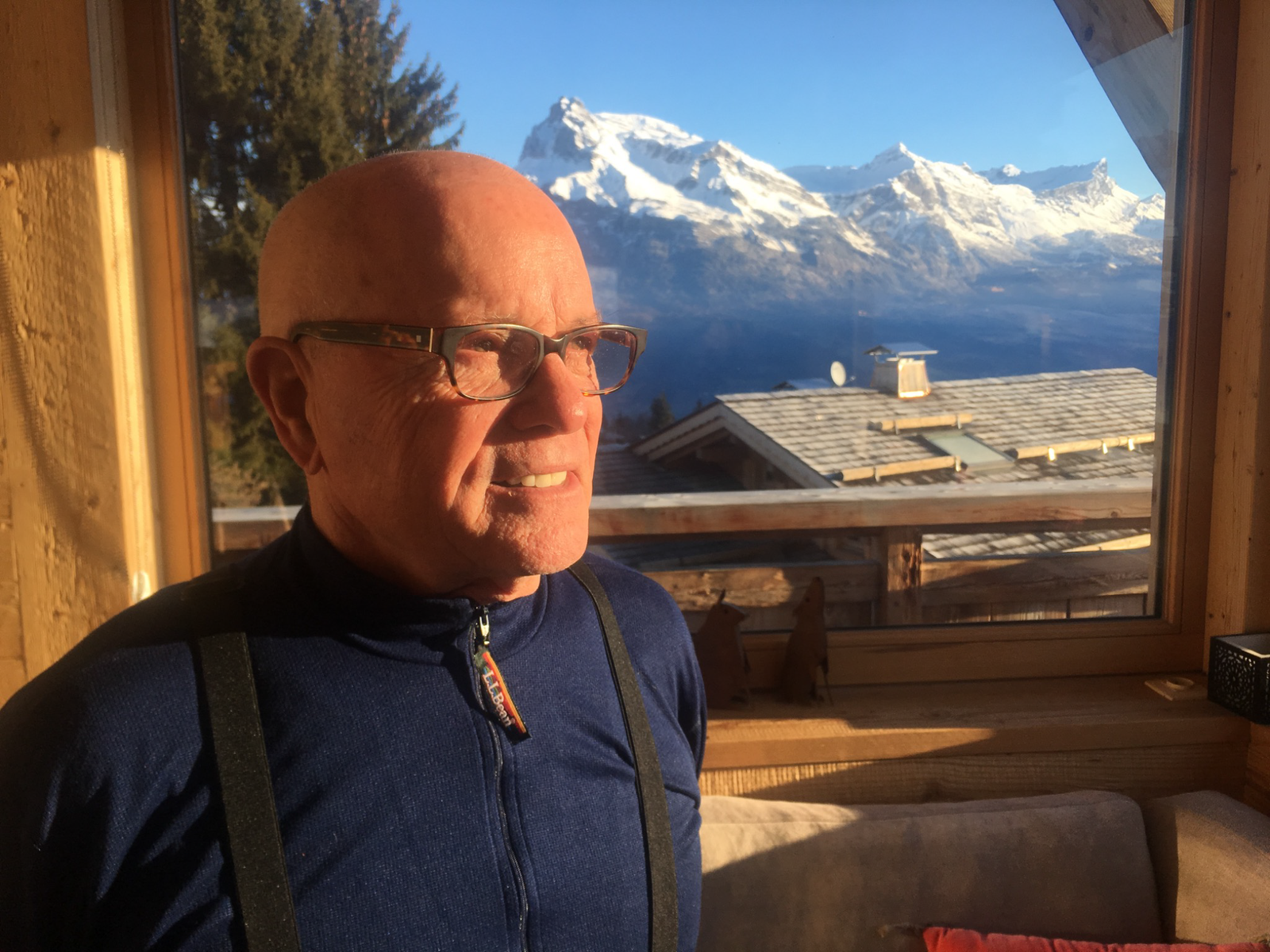
Michael Prentice
“I thought I was shaping stone.”
“Looking back, I realize stone was also shaping me.”
On material, imagination, architecture and a lifetime of making.
Origins and Apprenticeship
1. Mr. Prentice, your career has developed across painting, sculpture, architecture and monumental commissions, yet stone has ultimately become one of the defining languages of your practice. When you look back at the beginning of that journey, what was it about sculpture—and particularly the physical presence of stone—that convinced you this was the language through which you could say what painting could not?
From the time I was a young child, I was fascinated by the form and texture of things. I was also drawn to things of permanence—probably because there was a good deal of chaos in my childhood. By the time I was 19 and had begun seriously studying art, I knew that creating forms in stone was not simply the best thing for me to do. It was the only thing I could do.
2. You are described as a self-taught sculptor, while your academic background includes Art History at Middlebury College. How did studying the history of art, rather than receiving conventional studio training, influence the way you learned to see form, proportion, material and space?
I was a terrible student in school. I learn by doing, not by sitting in a classroom listening.
By the time I was eighteen, however, I had already seen a great deal of European and African art. I had lived in Egypt and three European countries, so when I arrived at Middlebury, majoring in art history seemed like a fairly painless route to graduation.
Apparently, not painless enough. By my sophomore year, I still needed to make up credits, so I went to Dartmouth Summer School intending simply to get them out of the way. Instead, I took drawing and sculpture classes, fell in love with working with my hands and watching forms and shapes come to life—and was hooked forever.
How I actually became a self-taught sculptor is another story. I certainly didn’t move to Paris intending to become one.
3. Your move to Paris in 1968 placed you inside an extraordinary European artistic environment, followed by participation in exhibitions including the Salons d’Automne, Grands et Jeunes d’Aujourd’hui and Réalités Nouvelles. What did Paris teach you about sculpture that could not have been learned in a classroom?
I went to Paris to study at the famous École des Beaux-Arts. My timing was impeccable: I arrived just as the May 1968 student riots erupted.
Getting to school meant navigating police, tear gas, barricades and young people throwing things. Eventually, formal education began to seem considerably more dangerous than teaching myself.
Paris was actually my second failed attempt at formal art training. The year before, I had tried to study in Barcelona, but the classes were all in Catalan. I spoke French, Italian and a smattering of Arabic—which, surprisingly, was of very little help.
So, after two unsuccessful attempts at formal study, I set out on my own. I knew the work of the great masters because I had studied them intensively, but I realized that knowing their work was not the same as knowing how to do the work. I needed the skills and techniques—the physical knowledge that comes through the hands.
Fortunately, the master sculptor André Del Debbio accepted my offer to become his assistant. Free labor is always welcome!
I learned a great deal from that apprenticeship, not only about technique but about myself as an artist. I discovered that additive sculpture in clay and plaster was not really my thing. I tried carving wood, but it didn’t feel permanent enough.
Then there was stone.
Stone was permanent. It endured. I knew immediately that it was my material. I also knew I had a great deal more to learn, so I went to Pietrasanta, Italy, and worked alongside a master carver in a town renowned for its marble and bronze craftsmanship.
In the end, my education happened exactly where it needed to happen: not in a classroom, but in workshops, with masters, tools, dust—and stone.
The Language of Stone
4. Your sculpture frequently brings together apparently opposite qualities: polished and rough, rigid and malleable, natural stone and other materials. You have spoken about wanting viewers to reach out and touch the surface. Is this physical invitation to touch part of your deeper philosophy of sculpture—that sculpture should be experienced by the body as much as by the eye?
Absolutely. Sculpture should be experienced through touch as well as sight.
That is one of the things I love about granite: a single material can produce an extraordinary range of surfaces. Rough, smooth, polished, textured—each one communicates something different. Sculpture occupies physical space with us. Why should we experience it only with our eyes?
5. Black granite occupies a particularly powerful position within your work. Its surface can appear almost architectural and immovable, yet you have described its ripples and bubbles as possessing the fluidity and characteristics of water. How did you discover this seemingly contradictory relationship between the weight of stone and the movement of water?
Deception.
That is part of what fascinates me about highly polished black granite. It is an enormously heavy, immovable material, yet its surface can reflect light and suggest movement, even water.
When I created the console for the entrance to Lacoste’s headquarters in Paris, I manipulated the granite so that the crocodile appeared to be moving forward through water. A massive piece of stone suddenly suggested fluidity.
I love that contradiction. Stone doesn’t have to behave the way you expect stone to behave.
6. Water appears repeatedly as a theme in your sculpture, while some of your forms have been described as suggesting seals, walruses or imaginary seahorses emerging from waves. When these organic or marine associations appear in your work, do you begin with an identifiable creature or natural form, or does the stone itself gradually reveal the image to you?
I sailed a great deal as a young man, and I have always loved water and the creatures that live in it. I love the fluidity of seals—and the magnificent ugliness of walruses.
When I sculpt these creatures, I usually begin with an image in my head. Then the rock begins to have opinions of its own.
One of my better pieces was inspired by an otter I saw swimming in the Connecticut River on a calm summer evening. Only its head was above the surface, creating this beautiful V-shaped wake. I recreated that image in black granite, using the polished stone to suggest the still surface of the river.
Was the finished sculpture exactly what I had seen? No. It couldn’t be. The granite had entered the conversation.
That is part of sculpting for me: I may begin with the idea, but the stone gets a vote.
7. You have worked with black granite, Carrara marble, basalt and bronze, while also combining materials such as rustic wood, gold and differently finished stone. When you begin a sculpture, does the material determine the idea, or does the idea determine which material you ultimately choose?
Both.
Sometimes I begin with a very specific idea and choose the material that will best realize it. Other times, I simply begin working with the stone and let it lead me somewhere I had not anticipated.
Sometimes I make a plaster model first and then enlarge it using the traditional pointing-up system, transferring three-dimensional coordinates from the model to a full-scale block of stone.
Many of my bronzes also originated as sculptures in other materials, particularly pieces from my bird series.
So there has never been one fixed process. Sometimes I tell the material what I want. Sometimes it tells me.
8. There is an important tension in your sculpture between what is deliberately untouched and what is highly refined. What does the untouched surface of a stone communicate that polishing cannot—and what does polishing reveal that the raw stone conceals?
Raw stone speaks loudly. Polished stone is more subtle.
I have always been extraordinarily sensitive to texture. Even floors communicate to me through my feet.
A highly polished marble floor says, “Danger! You could slip and fall.” My current bathroom floor, which is gently textured marble, says, “You can walk safely.” If it were much rougher, it would simply say, “Ouch.”
So perhaps I have spent my life listening to rocks—and apparently to bathroom floors.
Texture communicates emotion. That is true in my sculpture, but it is also true in my drawings. In the wild, colorful works that the retrospective calls the “Cosmic” collection, different textures draw the eye in much the same way that the surfaces of my sculpture invite touch.
Sculpture and Architecture
9. Your work has moved beyond the traditional boundaries of sculpture into architecture and interior environments. You created monumental granite doors and furniture for Cartier’s headquarters in Fribourg, and you were recognized in Paris for massive granite doors and a four-ton granite kitchen island. How do you think differently when sculpture must exist within architecture rather than simply stand independently as an artwork?
Architectural commissions give me an opportunity to create something exciting and new, but unlike an independent sculpture, they also have to serve visual and practical purposes. Those constraints don’t bother me. I enjoy them.
They also require collaboration—with architects, engineers, contractors and interior designers—and I have always enjoyed partnerships. There is something exciting about taking an idea that begins in one person’s imagination and watching a whole team figure out how to make it real.
I like being part of that process. I like being part of a team.
10. Your career has included commissions for private collectors as well as institutions, cities and major international clients. When a sculpture is commissioned, how do you negotiate between the identity and expectations of the client, the character of the site, and your own artistic integrity?
By the time I receive a commission, the hardest part is usually over: the client has already chosen me. Either they have faith in my work or I have won a competition.
I was very fortunate. I always felt I had considerable artistic freedom, and I never felt that my integrity as an artist was compromised. Amazingly, I also never had a client reject the finished work—which is probably because I had already pitched the idea. If they hated it, presumably they wouldn’t have hired me.
I never had an art agent. I made all my pitches myself, so the conversation between artist, client and site began with me.
And the site is never incidental. It is integral to the work. You cannot create a site-specific commission in a vacuum. The architecture, surroundings, scale and purpose all become part of the sculpture.
11. You established a granite-carving studio in Kerala, India, during the 1980s. What did working in India teach you about stone, craftsmanship, labor, environment or artistic culture that subsequently entered your international practice?
India taught me ancient, traditional methods of carving. In truth, every country where I worked taught me a different way of approaching stone, but Kerala was extraordinary.
We had no electricity, so everything was done by hand—including making our own tools. We created an entire community of artisans and workers, and we became like a family.
It was one of the most remarkable experiences of my life.
India also brought me into direct contact with elephants, which eventually led to Homage à Ganesh, my second show at the Grand Palais in Paris.
I am crazy about elephants. They are intelligent, beautiful and loving. Once you have spent time around them, it is difficult not to be humbled by them.
12. Your sculptures have entered the collections and environments of highly distinguished cultural figures and collectors, while your public commissions have taken your work into civic and architectural spaces. Does the meaning of a sculpture change for you when it moves from the studio into the private home, the public realm or an architectural setting?
Not really. Once a piece leaves my hands, it begins a life of its own.
But commissions and independent work had very different effects on my life. As I became more successful, I received more public and private commissions. The upside was obvious: I made more money and received more attention.
The downside was that success came with administration.
Commissions meant schedules, logistics, fabrication, installation, budgets and execution—all of which consumed time I might otherwise have spent creating. I didn’t have the budget for an administrative assistant and a project supervisor, so I ran everything myself.
Success gave me more work and less time to doodle and dream.
And artists need time to doodle and dream.
13. Looking across several decades of your practice, where do you see the greatest transformation in your sculpture—not simply in technique, but in the way you think about form, space and the human experience of encountering an object?
I have always thought of my art as interactive—a convergence between my intention, ideas and creativity and the observer’s senses, intellect and emotions.
Looking across the decades, I think the greatest transformation in my work was toward simplicity.
Over time, I became less interested in adding and more interested in discovering what could be removed. I was searching for the essence of something—its fundamental being.
Perhaps that is one of the things stone taught me: sometimes the most important act is not adding something, but finding what is already there.
14. Your work has often occupied a territory between fine art, architecture and design. Do you see these disciplines as fundamentally separate, or do you believe the strongest work can exist precisely where sculpture, architecture and design begin to overlap?
I believe some of the strongest work exists precisely where sculpture, architecture and design overlap.
Michelangelo’s frescoes would still be works of genius without the Sistine Chapel. But combine those frescoes with the architecture and construction of the chapel and something greater happens.
You achieve heaven.
That is what interests me—the moment when disciplines stop competing for attention and begin making one another more powerful.
15. You have also devoted significant energy to rebuilding collaboration between artists and architects, including through the Sharpstown Prize for Architecture and The Alta Arts. Why has the relationship between artists and architects remained important to you personally, and what do you believe contemporary culture has lost when those disciplines work in isolation?
Architecture that serves only a utilitarian purpose can become soulless and uninspiring. Architecture conceived with the sensibility of an artist can be extraordinarily powerful because, like any art form, it evokes emotion—awe, fear, repulsion, joy.
Architecture can even be used deliberately to shape human behavior and emotion. Albert Speer’s monumental architecture for Nazi Germany was designed in part to diminish the individual and exalt the authority of the state.
Now consider Frank Gehry. When you experience one of his buildings, from the inside or outside, you are not simply occupying a structure. You are experiencing art. You feel something—and, in his best work, I find that feeling uplifting.
That emotional dimension is what we lose when art and architecture are separated too completely.
Houston and a Living Legacy
16. The establishment of The Alta Arts in Houston represents another dimension of your legacy—creating opportunities for artists, performers, students and architects. At this stage of your life and career, what does it mean to you to build an environment in which other artists can develop, rather than concentrating exclusively on your own work?
Sculpting monumental stone is exhausting. It requires enormous amounts of time, physical strength and manpower. At 82, I have to acknowledge that I am no longer going to wrestle monumental blocks of granite into submission personally.
I am still very interested in seeing my designs manufactured and in collaborating with architects. Age may limit the physical scale of what I can execute myself, but it has not diminished my desire to create.
And something else has become increasingly important to me: helping other artists create.
Mentoring artists has always brought me joy. Providing an environment in which artists can work, perform, experiment and be seen brings me joy as well. Over the last five years, presenting art in all its forms—particularly in an underserved Houston community like Gulfton—has given me renewed purpose.
We have had the privilege of presenting extraordinary people: musician Paul English, actor Matthew Modine, poet Catherine Savage Brosman, photographer Bob Gomel and many others. At this stage of my life, that is deeply meaningful to me.
It is also great fun.
But perhaps most important, we have been able to help young and emerging artists here in Houston.
That may be my greatest joy.
17. Your upcoming Houston retrospective, Michael Prentice: Forged in Stone, brings together more than 200 sculptures, drawings, historical photographs and archival materials and represents the first major career-spanning retrospective of your work. When you see so much of your artistic history assembled in one place, does it change the way you understand your own career?
Yes. The retrospective has profoundly changed the way I see both my career and my art.
My active career as a sculptor lasted 34 years, from 1968 to 2002. At the time, I simply thought of those as my working years. I have always had the mentality of a worker. I never walked around thinking, “I am a great artist.”
I just couldn’t seem to do anything else.
I was compelled to make things. And because I was so busy making them, I never really stopped to consider how many things I had created. Through the retrospective, we have created a digital registry of over 650 of my pieces. And those are just the ones we have found. Over the next year, with the help of the public, I hope to find another 200.
I didn’t spend much time absorbing any accolades, either. I simply went on to the next piece.
What has surprised me most about the retrospective is seeing the work together and beginning to understand connections I couldn’t see while I was living them—how events in my life shaped the art, sometimes without my realizing it.
Now, for perhaps the first time, I am standing back and taking it all in.
It is wonderful.
It is also a little overwhelming.
18. The title Forged in Stone carries an almost biographical resonance. If you were asked to identify one central idea that has remained constant throughout your artistic life—beneath all the different materials, places, commissions and decades—what would that idea be?
Resilience.
Resilience driven by passionate commitment and, fortunately for me, a rather unreasonable amount of energy.
People may look at my background and assume I had an easy life. I did not. I have survived many challenges, and survival and resilience have been recurring themes throughout my life.
When I believe in something, I commit myself to it completely—whether that means realizing an artistic vision, helping the people I love, or trying to be useful to my country.
And I have been blessed with enormous physical energy throughout my life.
Perhaps stone was the ideal material for me after all. It takes a great deal of energy to argue with a rock.
19. Your sculptures have been presented internationally, yet your current retrospective in Houston brings the work into a particularly extensive dialogue with the public, architecture and your own documentary project. What do you hope a viewer who knows nothing about Michael Prentice will understand after encountering the retrospective for the first time?
First, I hope people leave with a sense of the possibilities of a rock.
What can a rock become? What can a piece of paper become? What can happen when imagination meets something as ordinary as a material sitting in front of you?
As for Michael Prentice—well, I suppose I would like them to understand that I am. That I was.
That there is an old man in Houston who spent his life looking at the world in his own peculiar way and tried to share some of what he saw through his art.
An artist bares something of himself every time he makes something and allows another person to look at it.
I suppose this retrospective is my way of opening the door a little wider and saying: Come in. Have a look.
What Endures
20. After decades of working with one of the most demanding and unforgiving materials an artist can choose, what still surprises you about stone? And is there something that the material has taught you about patience, time or permanence that you could never have learned from another medium?
Stone still amazes me.
A few years ago, I visited Göbekli Tepe in Turkey and stood before those enormous T-shaped pillars, beautifully carved more than 12,000 years ago. I remember thinking: We have always been fascinated by rocks.
There is something deeply human about that.
Stone also taught me patience, because I am NOT a patient man by nature.
Sometimes I think God deliberately led me to a medium that absolutely required patience because He knew I wasn’t going to learn it any other way.
Carving and, particularly, the repetitive process of polishing disciplined my boundless energy and forced my “monkey mind” to become quiet, to concentrate, even to meditate.
I thought I was shaping stone.
Looking back, I realize stone was also shaping me.
Sculpting forged my character.
21. Mr. Prentice, an artist eventually reaches a point where the question is no longer simply “What have I made?” but “What remains after I am gone?” When future generations encounter your sculptures without knowing the circumstances of their creation, what would you most want them to feel, discover or question—and what would you hope your work contributes to the larger history of sculpture?
One thing is certain: my sculptures will outlive me by hundreds of years.
I find that enormously comforting.
But longevity alone is not legacy. What I hope is that, long after anyone remembers the circumstances in which a particular sculpture was made, the work still causes someone to stop, look and feel something.
My work has dealt with animals and imaginary creatures, bodies with pleasure and pain, doorways and tables, birth and death—and whatever else viewers discover in it that I may never have consciously intended.
I would like people to look at familiar things in an unfamiliar way.
Perhaps that is all an artist can really ask: that something he made survives him, encounters another human being in another time, and makes that person see—or feel—the world a little differently.
If a piece of stone I touched can still do that hundreds of years from now, I will have contributed something.
And that makes me happy.
